
Overweight permits, from the 80,000-pound line to the bridges on your route.
An overweight permit is a state's written approval to run heavier than the legal limit, on roads and bridges the state picked for your load. Here are the limits that trigger one, which loads qualify, and why the route on an overweight permit matters as much as the weight.


An overweight permit lets you run a truck heavier than the legal limit on roads and bridges the state approved for your load. As with size permits, the states issue them. FHWA: “The Federal government does not issue permits for oversize or overweight vehicles. This is a State option.” Federal rules set the baseline, and each state decides how far past it you may go.
The limits that trigger an overweight permit
On the Interstate System and reasonable access to it, 23 CFR 658.17 sets three numbers:
- Gross weight: 80,000 pounds, unless the bridge formula gives you less.
- Single axle: 20,000 pounds.
- Tandem axle: 34,000 pounds, for two or more consecutive axles more than 40 inches and no more than 96 inches apart.
Those numbers include all enforcement tolerances. Go past any one and you need an overweight permit, even if every dimension is legal.
The bridge formula
Legal axles can still add up to an illegal truck. The bridge formula caps the weight on any group of two or more consecutive axles, using the number of axles and the distance between the outer ones. FHWA says Congress enacted it in 1975 “to limit the weight-to-length ratio of a vehicle crossing a bridge.”
FHWA’s own example: a five-axle tractor-semitrailer with 12,000 pounds on the steer axle and 17,000 on each of the other four grosses 80,000 pounds, and every axle passes. But axles 2 through 5 carry 68,000 pounds over 35 feet, and the formula allows 65,500 there. You fix it by removing load or spreading the axles. The bridge formula table lets you look up an axle group without doing the math.
Which loads qualify
Section 658.17(h) lets states “issue special permits without regard to the axle, gross, or Federal Bridge Formula requirements for nondivisible vehicles or loads.” Under 23 CFR 658.5, a load is nondivisible if splitting it would make the vehicle unable to do its job, destroy the load’s value, or take more than 8 work hours to dismantle. North Carolina’s handbook puts the practical rule in one line: “One item/commodity qualifies for overweight; multiple items do not qualify for an overweight permit.” See divisible vs nondivisible loads.
How a state sets your permitted weight
Each state writes its own permit weights. North Carolina’s handbook says the maximum permit weight “is determined by the number of load supporting axles; allowable bridge structure weights.” For a single-trip permit it lists 25,000 pounds on a single axle, 50,000 on tandem axles and 60,000 on tridem axles. Gross weight then depends on axle count and wheelbase: five axles get 94,500 pounds, or 112,000 with a minimum 51-foot wheelbase. Past 132,000 pounds, North Carolina treats the move as a superload, and its Superload Publication SL-6 asks for the application at least 10 business days ahead “to allow for internal and bridge engineering reviews.”
Before you apply
- Weigh each axle and axle group, and measure the spacing of each group.
- Run the bridge formula on your critical axle groups.
- Confirm the load is nondivisible under 23 CFR 658.5.
- Check your registered weight in every state. MnDOT: “Having an oversize/overweight permit does not increase your vehicle’s registered weight.”
- Find the state’s permit office. The post on where to apply for an oversize permit lists 14 states, and the states page links official permit information where we hold it.
What the permit asks of you on the road
An overweight permit often comes with bridge conditions. In Pennsylvania, if the permit requires reduced speed over bridges, a pilot car follows you while you run slow. If it requires you to be the only vehicle on a span, pilot cars lead and follow on two-way bridges. Pennsylvania also requires a brake retarder on any motor vehicle above 80,000 pounds gross on a state highway.
Weight alone can change your hours. Oklahoma’s ODOT says “Overweight only can have continuous travel.” North Carolina authorizes continuous travel up to a permitted gross of 112,000 pounds and up to 10 feet wide, if the move has no other over-legal height or length. The deep dive on how overweight permits work covers each rule.
Stay on the roads the state cleared
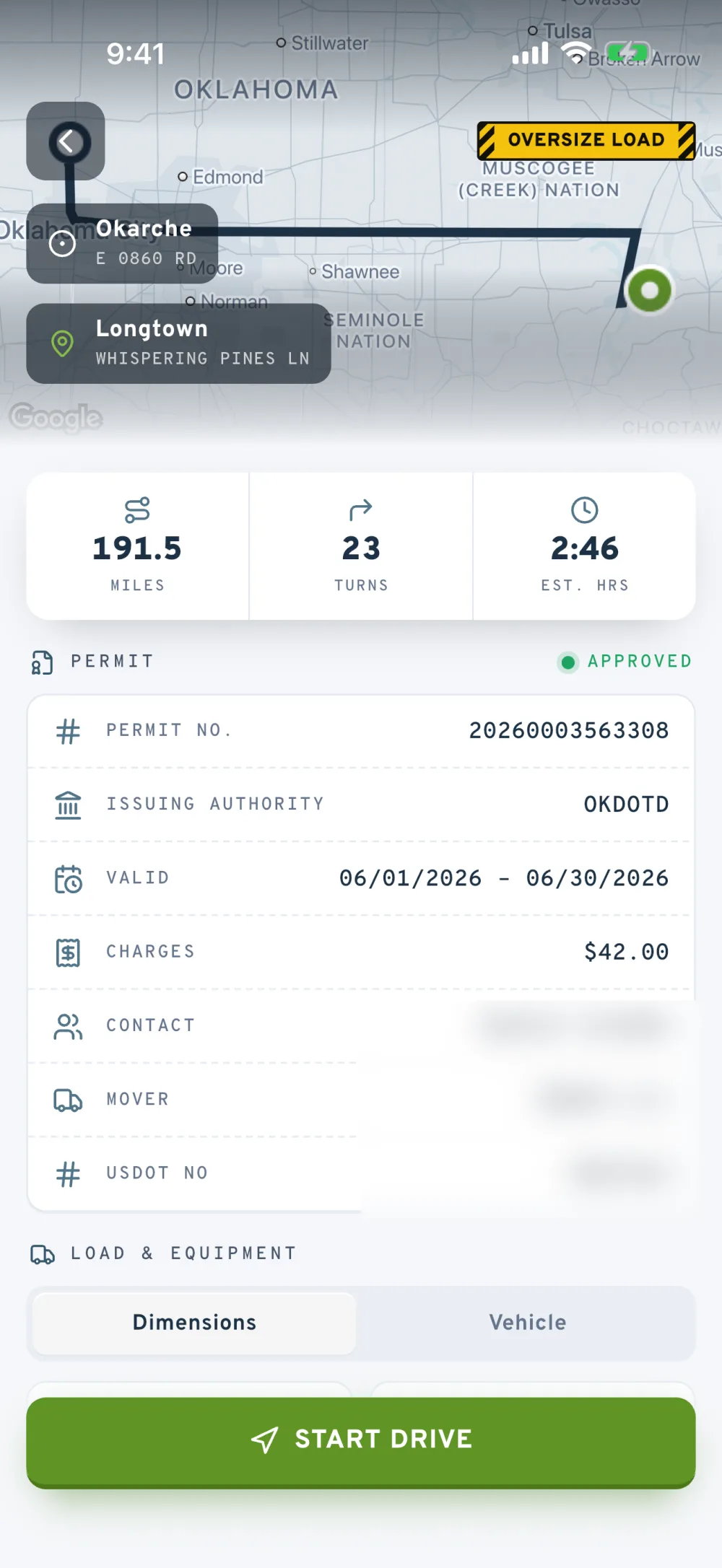
The state clears your weight for specific roads and bridges, so a wrong turn can put a heavy load on a bridge the state did not clear for it. Route Pilot Pro reads your permit from its QR code or PDF and guides you along the route it lists, marking any stretch it could not confirm against the permit. If your position moves more than 250 meters, about 820 feet, from the route line, the off-route alert warns you on screen and by voice and names the road to return to. You still carry the paper permit.
Sources
Checked 2026-11-05.
- 23 CFR 658.17, Weight: https://www.ecfr.gov/current/title-23/section-658.17
- 23 CFR 658.5, Definitions: https://www.ecfr.gov/current/title-23/section-658.5
- FHWA, Bridge Formula Weights (FHWA-HOP-19-028): https://ops.fhwa.dot.gov/freight/publications/brdg_frm_wghts/index.htm
- FHWA, Oversize/Overweight Load Permits: https://ops.fhwa.dot.gov/freight/sw/permit_report/index.htm
- NCDOT, Oversize/Overweight Permit Handbook: https://connect.ncdot.gov/business/trucking/Documents/Oversize%20Overweight%20Permit%20Handbook.pdf
- NCDOT, Superload Publication SL-6: https://connect.ncdot.gov/business/trucking/Documents/Superload%20Publication%20(SL-6).pdf
- 67 Pa. Code 179.10: https://www.pacodeandbulletin.gov/Display/pacode?file=/secure/pacode/data/067/chapter179/s179.10.html
- ODOT, Size and Weight Permits: https://oklahoma.gov/odot/about-us/laws-and-rules/size-and-weight-permits.html
- MnDOT, Determine if you need a permit: https://www.dot.state.mn.us/cvo/oversize/determine.html
Real screens from Route Pilot Pro.
-
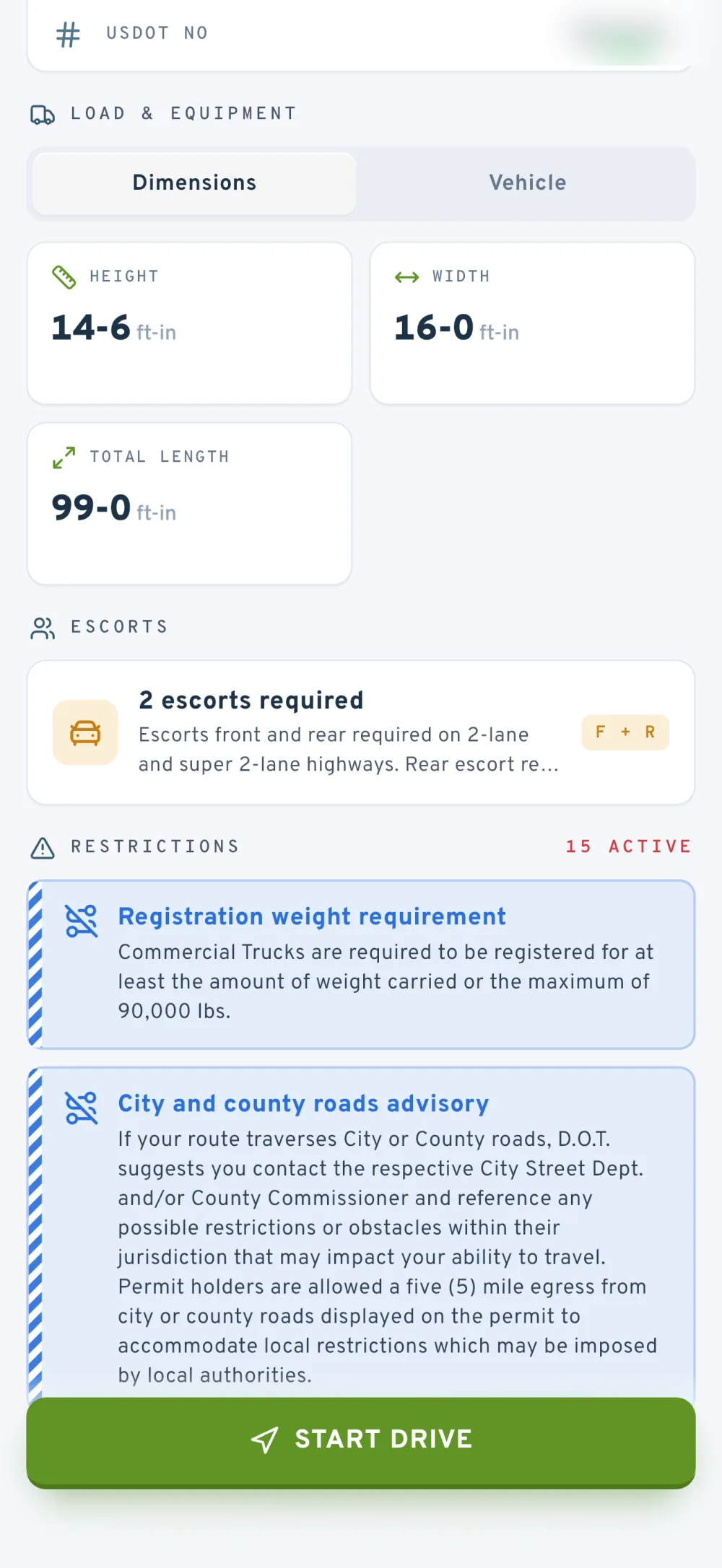
LoadLoad height, width, length and escorts
-
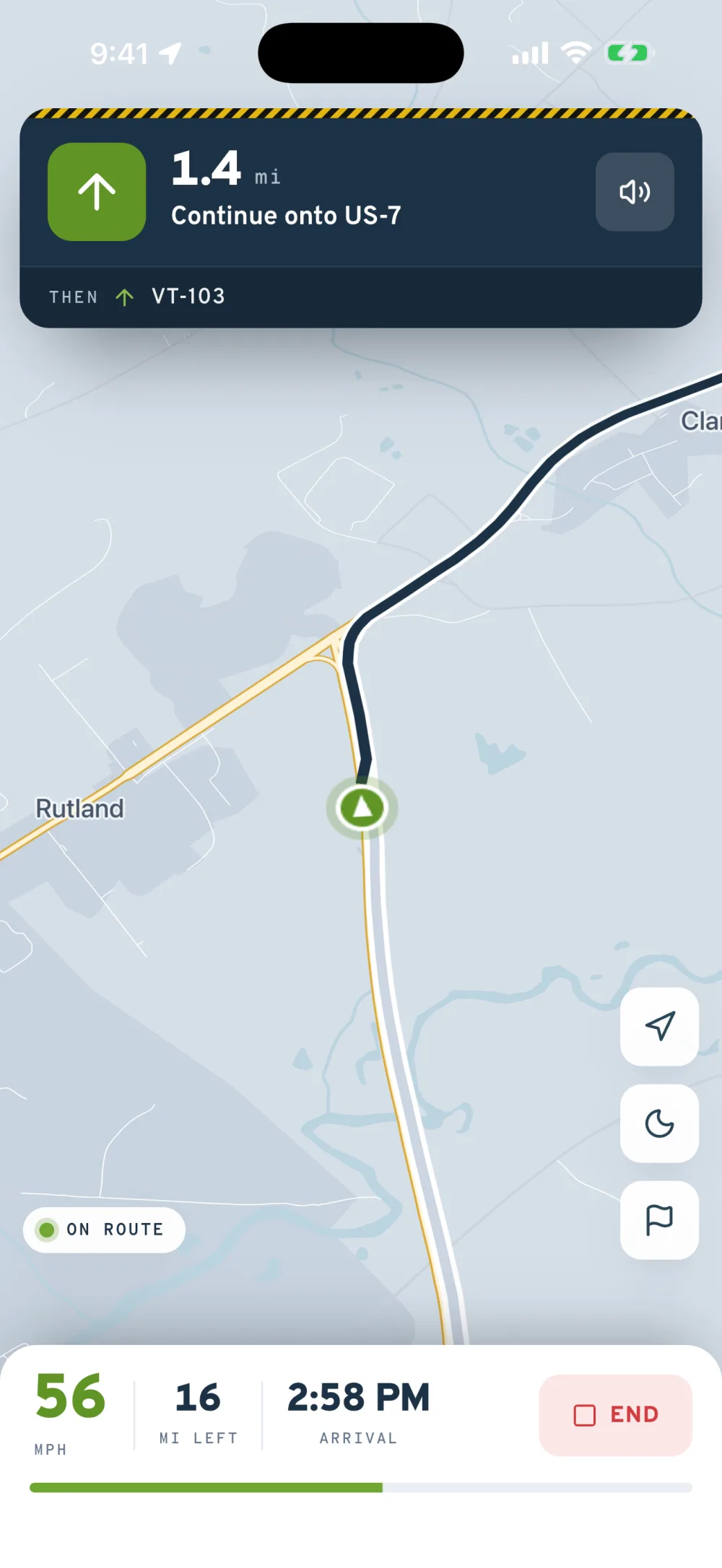
DriveNext turn, speed, miles left and arrival time
41 states and 2 provinces covered on official route data.
A state or province counts as covered when live permits there have a route verified on an official source. Each one counts once, under the source most of its permits use. Look up your state before a move.
See every state and province-
State and province road data
29 states and 2 provinces
We build the route on the road data the state or province itself publishes, and match the roads and junctions your permit names on it.
-
State permit portal route
9 states
Some state permit portals publish a route line for each permit. We load that line and run the same checks on it. The app needs the portal link on your permit, or a permit number it can look up.
-
Permit system route data
3 states
Some states issue permits through a system that supplies its own route data. We check your route against that data. This data belongs to the permit system and is separate from the state's own road data.
Common questions.
What weight needs an overweight permit?
On the Interstate System, more than 80,000 pounds gross, 20,000 pounds on a single axle or 34,000 pounds on a tandem, or more than the bridge formula allows for any axle group. States set their own limits on other roads.
Does an overweight permit raise my registered weight?
No. MnDOT says a permit "does not increase your vehicle's registered weight." Check registration in every state on the route before you apply.
Can I get an overweight permit for a divisible load?
Rarely. Permits generally cover nondivisible loads. North Carolina's rule is that one item qualifies for an overweight permit and multiple items do not.
Why does the route matter so much on an overweight permit?
The state clears your weight for specific roads and bridges. North Carolina's single-trip overweight permit is route specific, with an exact origin, detailed route and exact destination.
Keep reading
Scan your next permit and drive the route it approves.
Download Route Pilot Pro on iPhone or Android, scan the QR code on your permit and start the drive.