Oversize load routing starts with the state, and ends in your cab.
On a permitted load, the state chooses the roads. Your part of routing is to plan the trip around that route and drive it exactly. Here is how each piece works, and how Route Pilot Pro turns the permit's list of roads into a route you can follow.


For a legal-size truck, routing means picking a good way from A to B. For an oversize or overweight load, most of that choice belongs to the state. You propose the trip, the permit office decides which roads your load may use, and the permit you get back lists them. Routing for you comes down to three jobs: get the route right on the application, plan the trip around the route you receive, and drive it exactly.
The state picks the roads
North Carolina asks applicants for the “exact origin, detailed route and exact destination,” with county and state road numbers. The route the state approves then goes on the permit. Pennsylvania’s rule says the permit “shall authorize movement only on the roadway portion of highways specified in the permit.”
The state builds your route around what it knows about its own roads. It may leave a road off your permit for a posted bridge, a low structure, a tight turn or construction. North Carolina’s handbook says each permit carries requirements and restrictions “customized on each permit document for the load being transported.” That is why two loads between the same towns can get different routes. A bridge that carries one load may not carry a heavier one, and a route that clears 14 feet may not clear 15. The post on bridge and height restrictions covers how those limits shape a route.
Very large loads take more work. A superload often needs extra review before the state issues a route, and some states ask for a route survey, a drive of the full route to check clearances, turns and bridges. See what a route survey is and when you need one.
What route planning is left to you
Once the permit is issued, you plan the trip around the route instead of choosing a new one. That means:
- Dates and hours. Your permit sets its valid dates and often your travel hours. Holiday and rush-hour rules can block whole days. The guide to oversize travel times, curfews and holiday rules has the details.
- Escorts. The permit says how many escorts you need and where they run. Book them early.
- Fuel, parking and rest. Plan stops that a load your size can reach without leaving the listed roads.
- The turns. FHWA tells escort operators to “compare the permitted route to an actual map to make sure the route specified is understood.” Do the same as the driver, one road at a time.
The post on planning an oversize move lays out the week before you roll.
How Route Pilot Pro turns a permit into a route
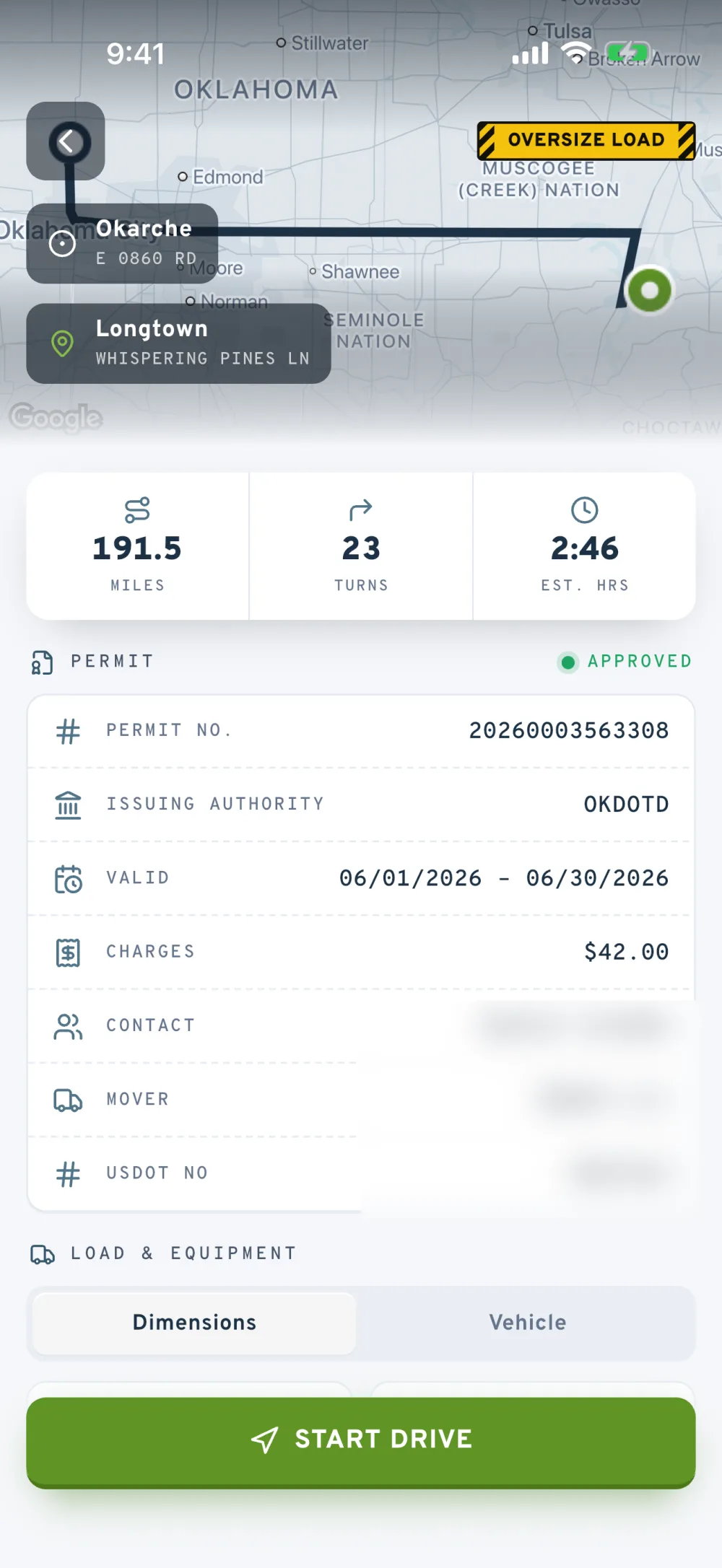
Route Pilot Pro does not plan a route of its own. It reads the route from your permit and draws it:
- Load the permit. Scan the QR code, or open the permit PDF if there is no code. The app reads the permit number, route, load dimensions, valid dates and restrictions.
- Get the route line. Where the state permit portal or the permit system publishes the route for your permit, the app loads that line. Elsewhere it matches the roads and junctions the permit names, on the state’s own road data where it holds that data and on other road data where it does not.
- Draw the route. It draws a drivable line through the matched junctions in order, along the roads the permit names instead of the fastest way.
- Check it. It scores the drawn route against the permit and marks it verified only if it passes every check.
Those checks include: the route follows the named roads in the permit’s order, it does not run a long stretch on roads the permit does not name, it does not jump a gap, and it is not materially shorter than the mileage on the permit. The full list is on the verification page.
Confirmed miles and miles to check
The route map marks each stretch “On the permit” or “Check against the permit”. A bar splits the trip into confirmed miles and miles to check, placed where they fall along the route. Stretches on city or county roads are tagged local. In Pennsylvania, for example, the state rule requires permission from local authorities to use local roads and streets, so check those legs against any local permission you hold.
If the app cannot confirm a route at all, it shows no line and tells you to follow the printed permit. It never fills the gap with a general route. Blanket permits have no fixed route, and the permit screen says so.
Then drive it
With the route drawn and checked, approved-route navigation guides you along it turn by turn, voice guidance reads each turn aloud, and off-route alerts warn you on screen and by voice if your position moves more than 250 meters, about 820 feet, from the line. You still carry the paper permit, and where the app and the permit differ, the permit wins.
Sources
Checked 2026-11-05.
- NCDOT, Oversize/Overweight Permit Handbook: https://connect.ncdot.gov/business/trucking/Documents/Oversize%20Overweight%20Permit%20Handbook.pdf
- 67 Pa. Code 179.10: https://www.pacodeandbulletin.gov/Display/pacode?file=/secure/pacode/data/067/chapter179/s179.10.html
- FHWA, Pilot/Escort Vehicle Operators Best Practices Guidelines (FHWA-HOP-16-051): https://ops.fhwa.dot.gov/publications/fhwahop16051/fhwahop16051.pdf
Real screens from Route Pilot Pro.
-
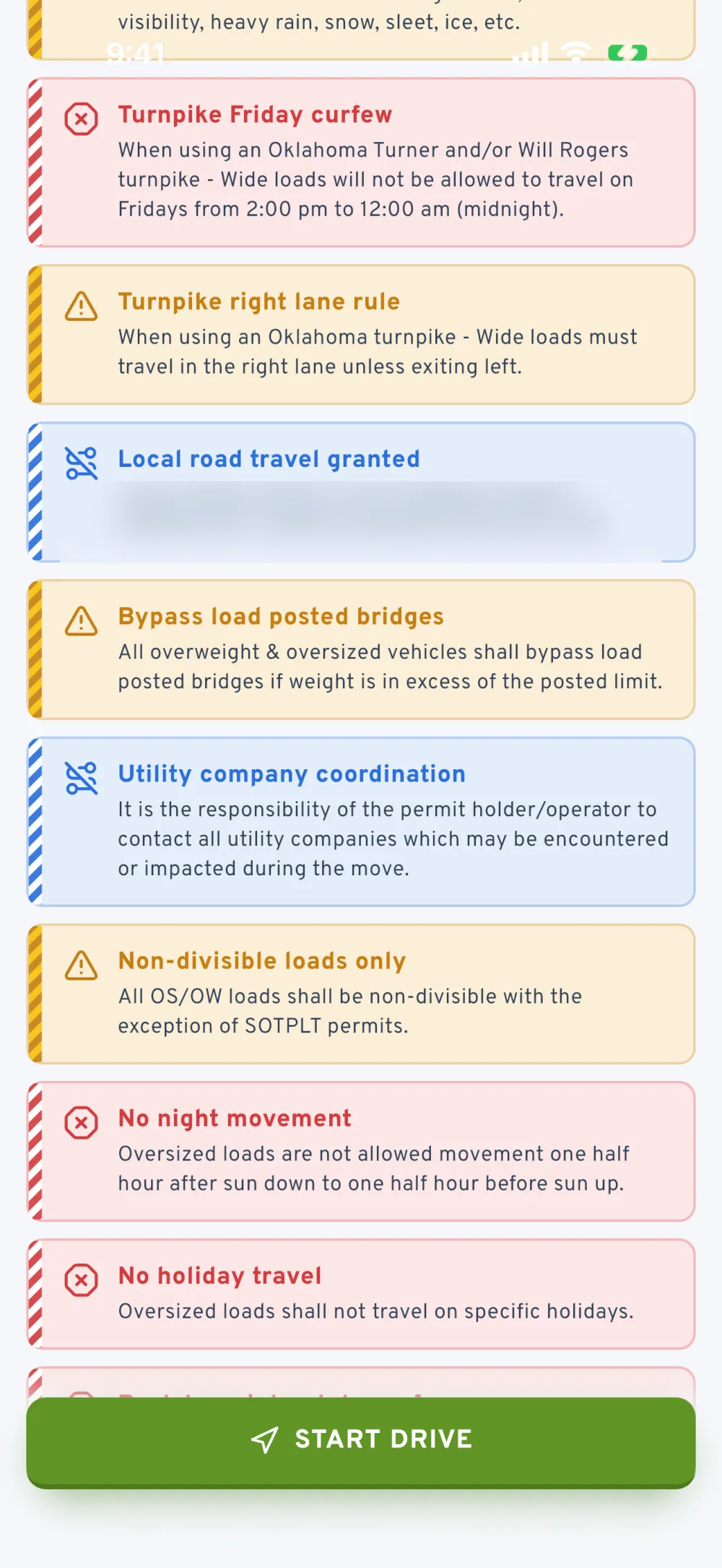
RestrictionsRestrictions listed from the permit
-
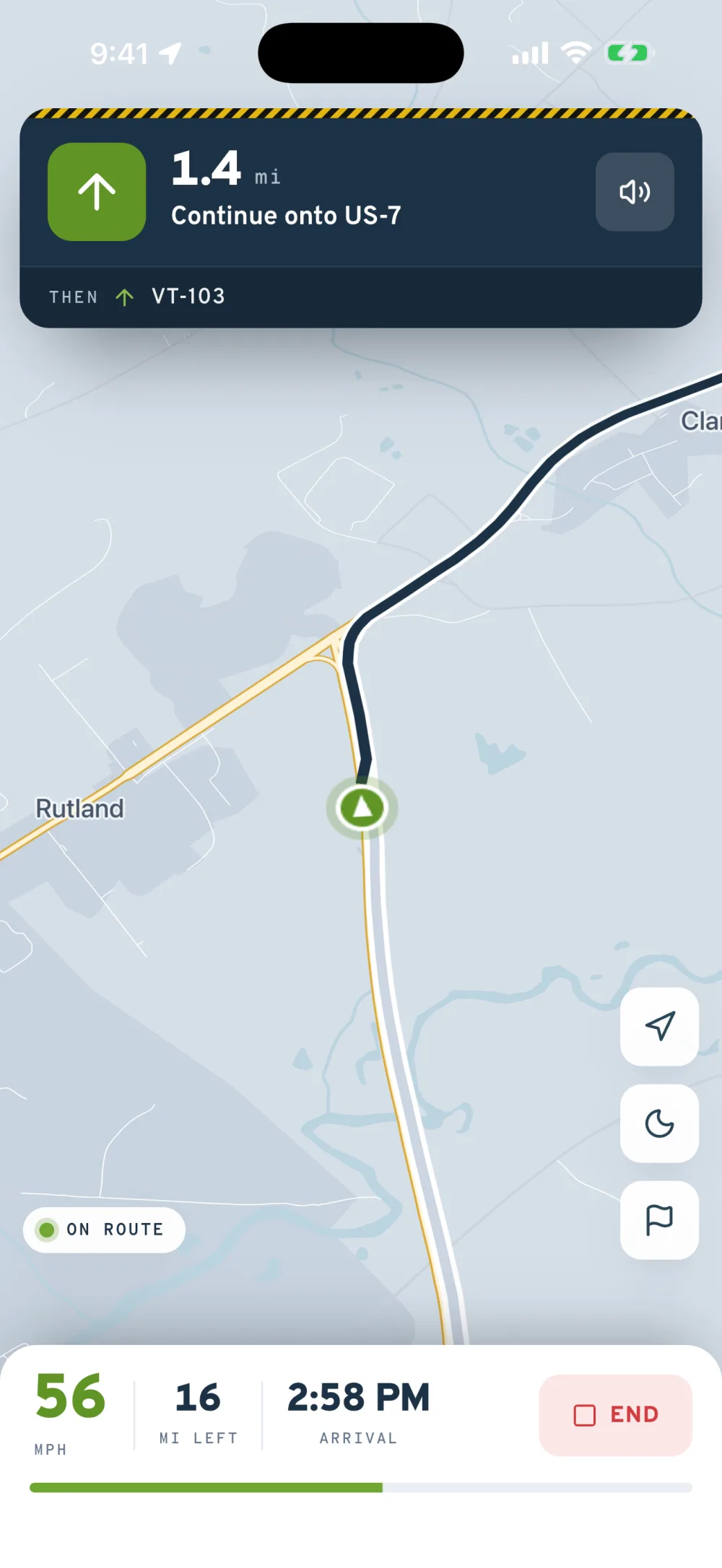
DriveNext turn, speed, miles left and arrival time
41 states and 2 provinces covered on official route data.
A state or province counts as covered when live permits there have a route verified on an official source. Each one counts once, under the source most of its permits use. Look up your state before a move.
See every state and province-
State and province road data
29 states and 2 provinces
We build the route on the road data the state or province itself publishes, and match the roads and junctions your permit names on it.
-
State permit portal route
9 states
Some state permit portals publish a route line for each permit. We load that line and run the same checks on it. The app needs the portal link on your permit, or a permit number it can look up.
-
Permit system route data
3 states
Some states issue permits through a system that supplies its own route data. We check your route against that data. This data belongs to the permit system and is separate from the state's own road data.
Common questions.
Can I plan my own route for an oversize load?
You propose a route when you apply, and the state decides which roads go on the permit. Once it is issued, the permit route is the one you drive.
Is Route Pilot Pro a route planner?
It draws the route your permit lists and checks it against the permit. It does not plan a new route or pick faster roads.
Why are some miles marked to check?
They are stretches where the app could not match the line to the roads on your permit. Read the written directions for those miles.
Does the app route local roads?
Stretches on city or county roads are tagged local, because the state does not set a route for them. Check those legs against your permit and any local permit you hold.
Keep reading
Scan your next permit and drive the route it approves.
Download Route Pilot Pro on iPhone or Android, scan the QR code on your permit and start the drive.