
Oversize load permits, explained for the driver who needs one.
An oversize load permit is a state's written approval to move a load past its legal width, height or length, on roads the state chose. Here is when you need one, how to get one in each state, and what it asks of you once you hold it.


An oversize load permit lets you move a truck and load that goes past the legal width, height or length on the roads you plan to use. The state that owns those roads issues it. FHWA puts it plainly: “The Federal government does not issue permits for oversize or overweight vehicles. This is a State option.” So a move that crosses three states needs three permits, one from each.
When a load needs an oversize permit
Start with the legal limits in every state on the route.
Width. Under 23 CFR 658.15(a), no state may set a width limit “of more or less than 102 inches” on the National Network, and Hawaii keeps 108 inches. A load over 8 feet 6 inches wide needs a permit on those roads. The load itself always counts in the measurement: a 9-foot machine on an 8-foot-6 deck is 9 feet wide. The wide load permit page covers width in detail.
Height. FHWA says “there is no Federal vehicle height requirement,” so each state sets its own. Minnesota and Oklahoma list 13 feet 6 inches as the point where you need a permit. North Carolina sets it at 14 feet. A load 13 feet 9 inches tall needs a permit in the first two and not in the third.
Length. Federal rules set minimum lengths states must allow, and the states set the rest. Minnesota requires a permit past 45 feet for a single vehicle or 75 feet for a combination. North Carolina’s limits are 40 feet for a single vehicle and 60 feet for a combination, with no overall limit for a tractor pulling a 53-foot semitrailer.
Weight is a separate test. A legal-size load can still need an overweight permit.
The guide to legal size limits has the full federal rules and more state examples.
What loads qualify
Permits generally cover nondivisible loads. Under 23 CFR 658.5, a load is nondivisible if splitting it would make it unable to do its job, destroy its value, or take more than 8 workhours to dismantle, and you carry the burden of proving the workhours. North Carolina’s handbook adds that it is “the responsibility of the permittee to reduce all overdimension and/or overweight loads to the least dimension and weight prior to application.” See divisible vs nondivisible loads.
Which permit type you need
Most states offer a single-trip permit for one move and some form of annual or blanket permit for repeat moves inside set limits. North Carolina’s single-trip permit is valid 10 calendar days for one trip. Its annual permit is valid one year, with a 12-foot width cap for general commodities. Very large moves fall into a superload category with longer review. In North Carolina that starts at 17 feet wide or more than 132,000 pounds.
How to get an oversize load permit
- Find the state’s permit office or online system. The post on where to apply for an oversize permit lists the official office and system for 14 states. Each state page on this site links the official permit information where we hold it, for example Pennsylvania, North Carolina and Minnesota.
- Gather the details. Expect to give plates and VINs, axle count, spacing and weights, gross weight, and overall width, height, length and overhang. For a route-specific permit, North Carolina asks for the “exact origin, detailed route and exact destination.”
- Apply early for big loads. North Carolina asks for superload applications at least 10 business days ahead so its engineers can review the bridges.
- Pay the fee. Each state sets its own. See how oversize permit fees work.
The step-by-step guide to getting your own oversize permit covers accounts and how to tell when the permit is done.
What the permit asks of you on the road
The permit lists your route and conditions. FHWA’s escort guidelines note that “most permits also specify the number of escorts required (both civilian and law enforcement escorts), the origination and final destination points, curfews, and other restrictions.” Pennsylvania requires the driver to carry the permit in the permitted vehicle and show it on request, and lets you leave the authorized route only when a police officer directs you to. The guide to following your permit route turns those rules into a routine.
Where Route Pilot Pro fits
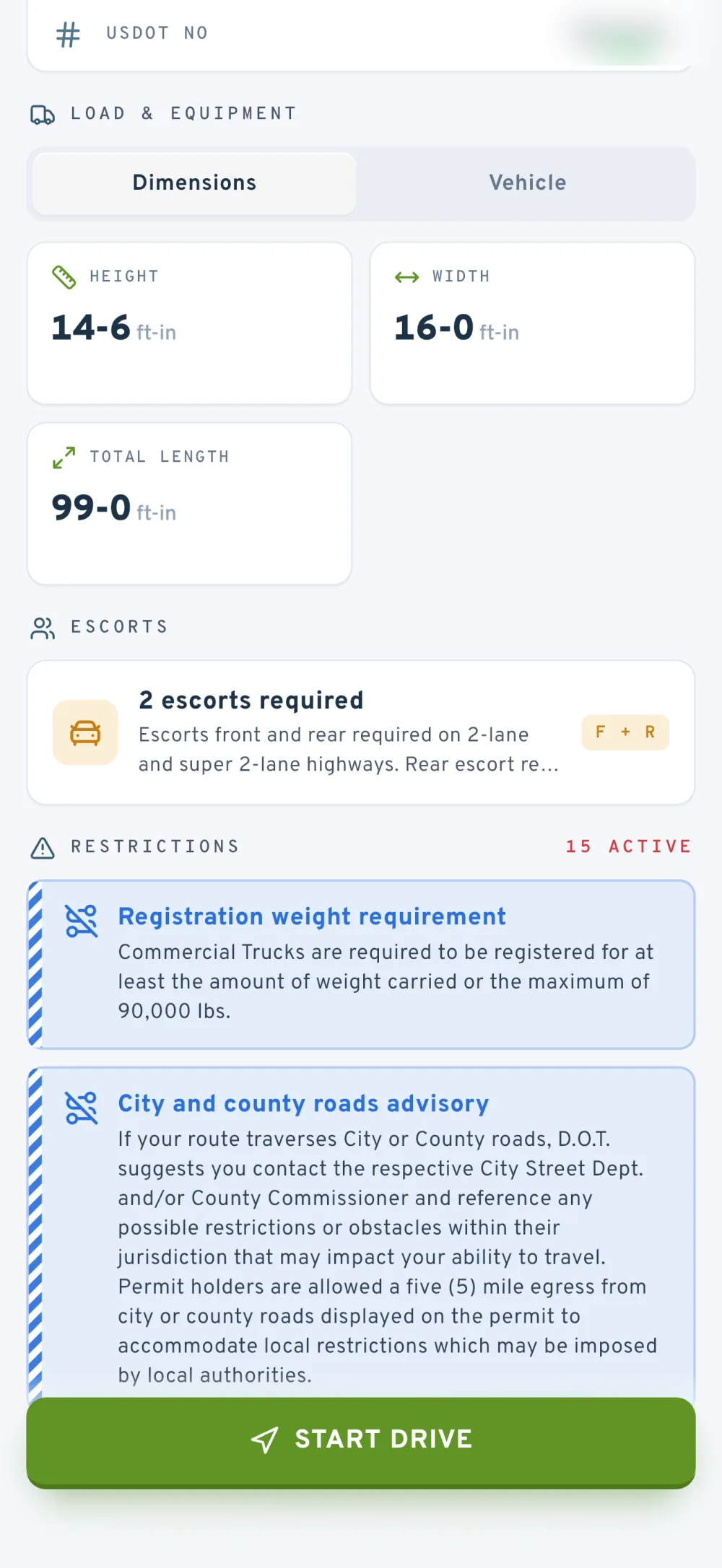
Once the state issues your permit, Route Pilot Pro reads it from the QR code or the emailed PDF and shows the route, load dimensions, valid dates, escorts and restrictions on one screen. It guides you along the route by voice and warns you if you leave it. You still carry the paper permit, and the printed permit is the legal document.
Sources
Checked 2026-11-05.
- FHWA, Oversize/overweight permits, Federal requirements: https://ops.fhwa.dot.gov/freight/sw/permit_report/index.htm
- FHWA, Federal Size Regulations for Commercial Motor Vehicles: https://ops.fhwa.dot.gov/freight/publications/size_regs_final_rpt/index.htm
- 23 CFR Part 658 (sections 658.5, 658.13, 658.15), eCFR: https://www.ecfr.gov/current/title-23/chapter-I/subchapter-G/part-658
- FHWA, Pilot/Escort Vehicle Operators Best Practices Guidelines, Chapter 1: https://ops.fhwa.dot.gov/publications/fhwahop16051/ch1.htm
- MnDOT, Determine if you need a permit: https://www.dot.state.mn.us/cvo/oversize/determine.html
- Oklahoma DOT, Size and Weight Permits: https://oklahoma.gov/odot/about-us/laws-and-rules/size-and-weight-permits.html
- NCDOT, Oversize/Overweight Permits: https://connect.ncdot.gov/business/trucking/pages/overpermits.aspx
- NCDOT, Oversize/Overweight Permit Handbook: https://connect.ncdot.gov/business/trucking/Documents/Oversize%20Overweight%20Permit%20Handbook.pdf
- NCDOT, Superload Publication SL-6: https://connect.ncdot.gov/business/trucking/Documents/Superload%20Publication%20(SL-6).pdf
- 67 Pa. Code 179.10: https://www.pacodeandbulletin.gov/Display/pacode?file=/secure/pacode/data/067/chapter179/s179.10.html
Real screens from Route Pilot Pro.
-
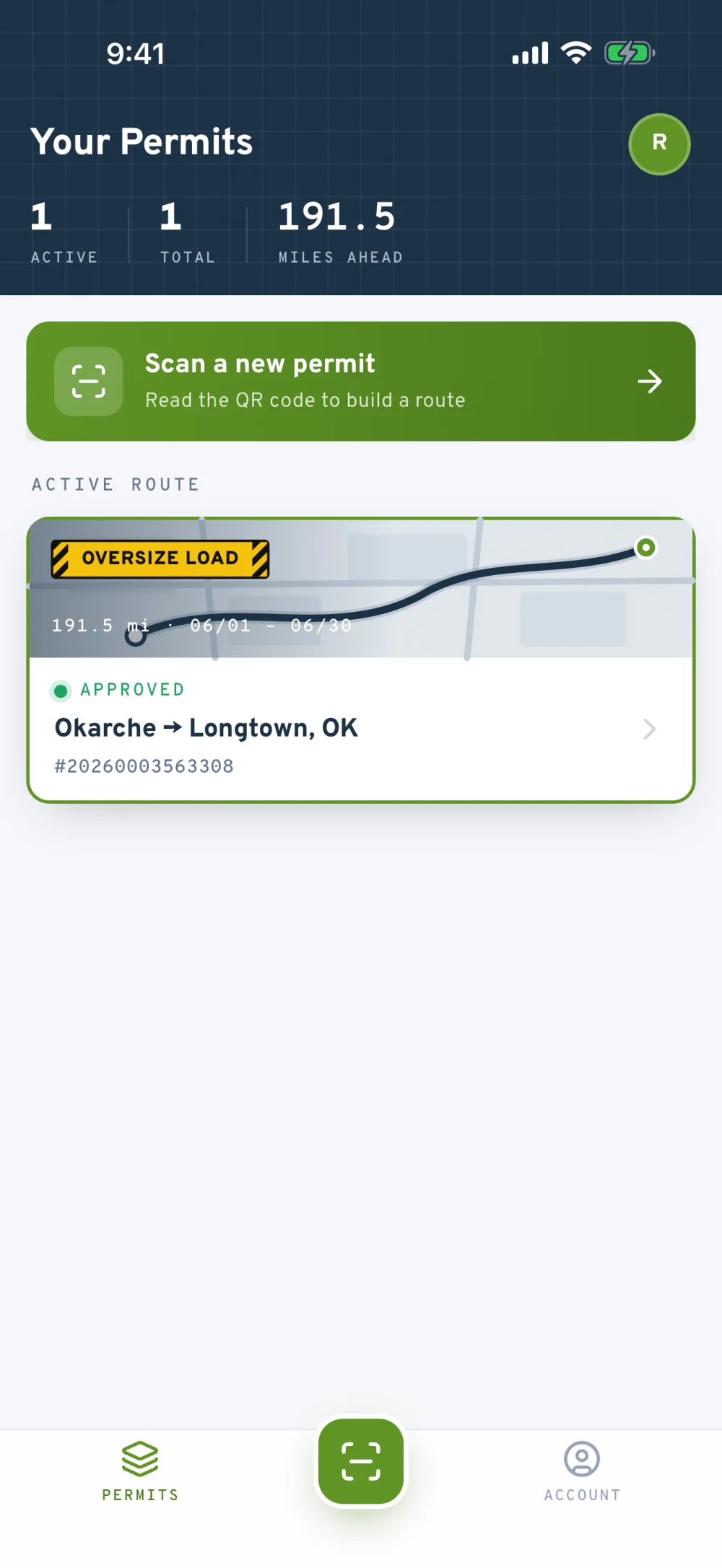
PermitsYour permits and the active route
-
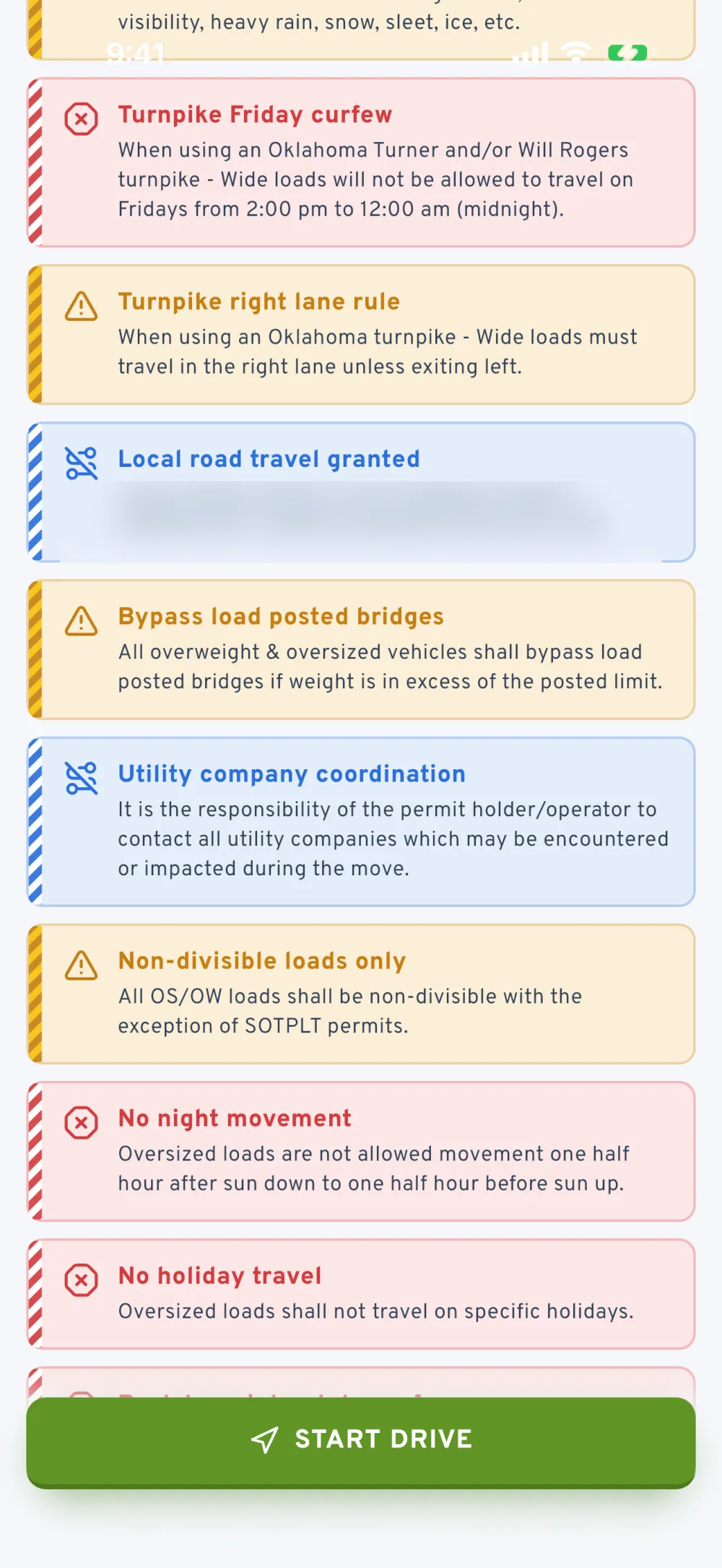
RestrictionsRestrictions listed from the permit
41 states and 2 provinces covered on official route data.
A state or province counts as covered when live permits there have a route verified on an official source. Each one counts once, under the source most of its permits use. Look up your state before a move.
See every state and province-
State and province road data
29 states and 2 provinces
We build the route on the road data the state or province itself publishes, and match the roads and junctions your permit names on it.
-
State permit portal route
9 states
Some state permit portals publish a route line for each permit. We load that line and run the same checks on it. The app needs the portal link on your permit, or a permit number it can look up.
-
Permit system route data
3 states
Some states issue permits through a system that supplies its own route data. We check your route against that data. This data belongs to the permit system and is separate from the state's own road data.
Common questions.
Who issues oversize load permits?
The states. FHWA says the federal government does not issue permits for oversize or overweight vehicles. A move through three states needs a permit from each of the three.
How wide can a load be without a permit?
On the National Network, federal rules set the width at 102 inches, or 8 feet 6 inches, with Hawaii at 108 inches. Height and length limits come from each state, so check every state on your route.
Can I get a permit for a load I could split up?
Permits generally cover nondivisible loads. Under the federal definition, a load is nondivisible if splitting it would ruin its function or value, or take more than 8 workhours to dismantle.
Does Route Pilot Pro issue permits?
No. You order the permit from the state. Route Pilot Pro reads the permit once you hold it and guides you along the route it lists.
Keep reading
Scan your next permit and drive the route it approves.
Download Route Pilot Pro on iPhone or Android, scan the QR code on your permit and start the drive.