
How to follow your oversize permit route, turn by turn.
Your permit route is a list of roads the state approved for your load. Following it means knowing every turn before you roll, staying on the listed roads, and knowing what to do when something goes wrong. Here is a step-by-step routine, with the rules behind it.


A permit route leaves no room for shortcuts. Pennsylvania’s rule says the permit “shall authorize movement only on the roadway portion of highways specified in the permit.” North Carolina’s handbook says violations of the route of travel “may result in the permit being considered invalid,” and lists a civil penalty for “moving a load off the route specified in the permit.” The routine below keeps you on the listed roads from the yard to the delivery.
Before you roll
1. Read every line of the route
Start with the paper. Read the route from origin to destination and trace each road and each turn on a map. FHWA tells escort operators to “compare the permitted route to an actual map to make sure the route specified is understood.” The same check works for the driver. Mark the interchanges, the exits the permit names and any road that changes number partway. The guide on how to read an oversize permit shows where the route sits on a typical permit.
2. Check the dates and hours
The route is only good inside the permit’s valid dates, and many permits limit your travel hours. Holidays and city curfews can block days you planned to run. See oversize travel times, curfews and holiday rules and night and weekend travel.
3. Read the conditions that ride with the route
Escorts, travel times, equipment rules and other conditions ride with the route, and some apply only to certain roads on it. The post on reading the restrictions on your oversize permit explains the common ones.
4. Brief your escorts
FHWA’s pre-trip meeting guidance says to “ensure all team members know the route, turn by turn (even rear escort drivers).” A lead car that knows the next turn can warn you early. Pilot car rules differ by state, so check each state on the move. Start with pilot car rules by state and the guide on how to check escort requirements.
5. Survey the route when the load calls for it
For tall, wide or heavy loads, a route survey drives the full route ahead of time to check clearances, turns, grades and bridges. Some states require one for their largest loads.
On the road
6. Stay on the listed roads
Do not follow a detour sign, a GPS reroute or a shortcut onto a road your permit does not name. Pennsylvania lets a permitted vehicle leave its authorized route “only when specifically directed by a police officer.” North Carolina allows a narrow exception for access: on interstate segments, up to one mile off the permitted route onto another state highway, if you cross no bridges and exceed no posted weight limits.
7. If a road is closed, call the permit office
A closure does not give you permission to pick a new road. Call the office that issued the permit and follow any police officer directing traffic. If the route has to change, ask how to amend the permit. The post on amending an oversize permit covers what four states let you change.
8. If you miss a turn, get back on the route
FHWA lists “getting back on a route after a wrong turn” among the costly results of poor pre-trip planning. With a large load there may be no safe place to turn around, so the best fix is the first one: know each turn before you reach it. If you do miss one, return to the permitted route by the safest legal way and avoid running further on unlisted roads. The post on leaving the permitted route covers the rules and penalties.
How Route Pilot Pro helps at each step
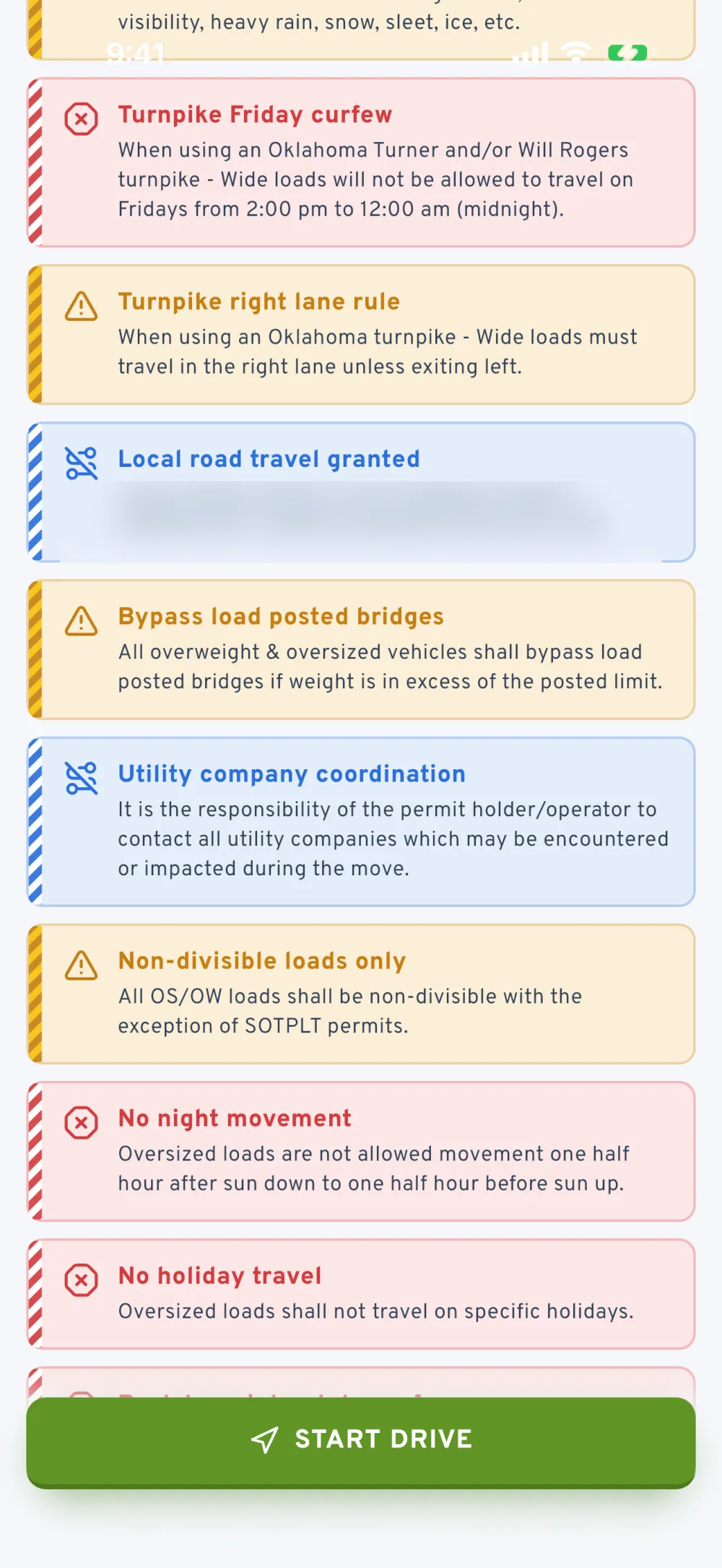
Route Pilot Pro is a driving aid built for this routine. You scan the QR code on your permit and the app draws the route it lists, so steps 1 to 3 happen on one screen: route miles, turns and estimated hours, valid dates, load dimensions, escorts and restriction cards. The map marks each stretch “On the permit” or “Check against the permit”, so you know which miles to check against the written directions.
On the road, voice guidance reads each turn with its distance before you reach it. If your position moves more than 250 meters, about 820 feet, from the route line, the off-route alert turns the banner red, names the road to return to and says “You appear to be off route”. It points you back to the permitted route and does not plan a new one. You still carry the paper permit, and the permit decides what is legal.
Sources
Checked 2026-11-05.
- 67 Pa. Code 179.10: https://www.pacodeandbulletin.gov/Display/pacode?file=/secure/pacode/data/067/chapter179/s179.10.html
- NCDOT, Oversize/Overweight Permit Handbook: https://connect.ncdot.gov/business/trucking/Documents/Oversize%20Overweight%20Permit%20Handbook.pdf
- FHWA, Pilot/Escort Vehicle Operators Best Practices Guidelines (FHWA-HOP-16-051): https://ops.fhwa.dot.gov/publications/fhwahop16051/fhwahop16051.pdf
- FHWA, Pilot/Escort Guidelines, Chapter 2, Pre-Trip Safety Meeting: https://ops.fhwa.dot.gov/publications/fhwahop16051/ch2.htm
Real screens from Route Pilot Pro.
-
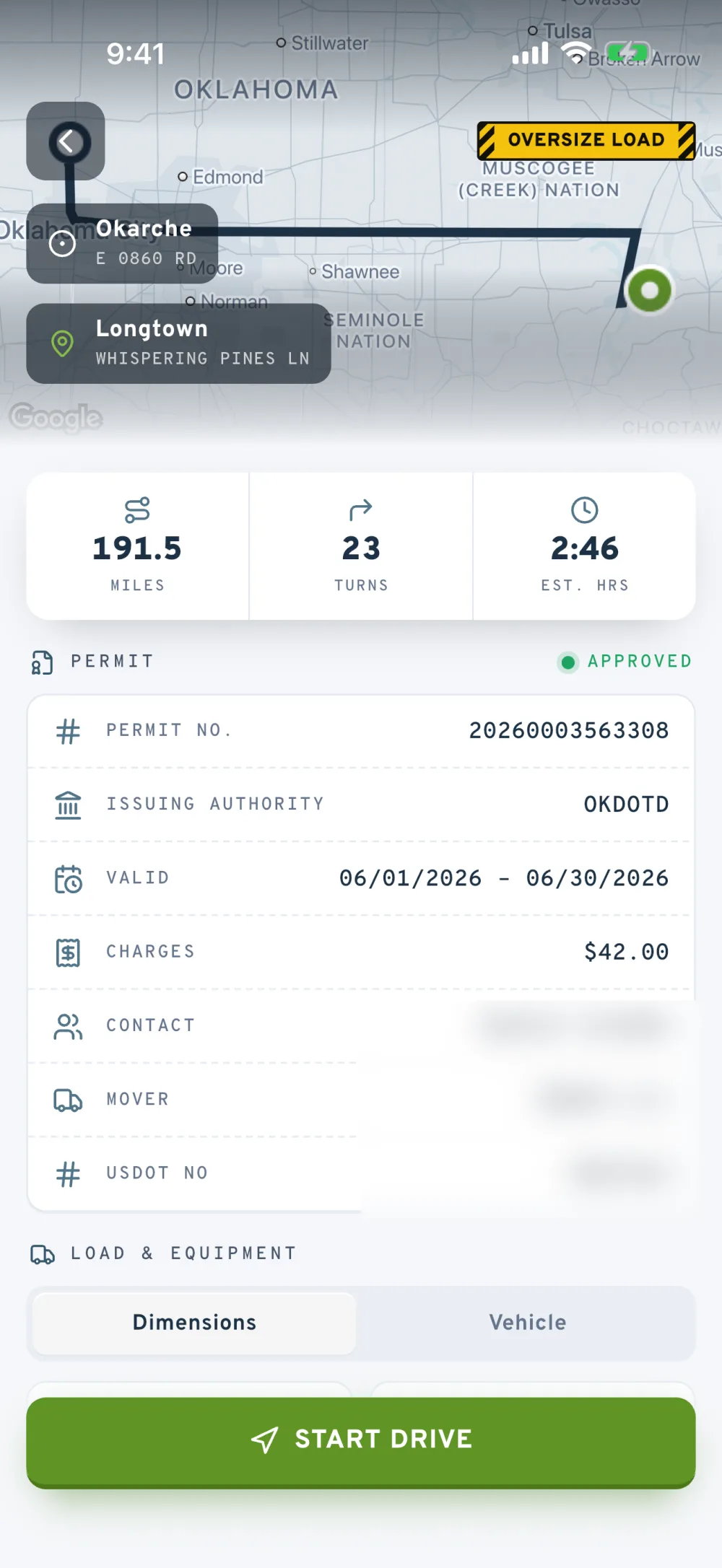
ReviewRoute review: 191.5 miles, 23 turns, 2:46 estimated hours
-
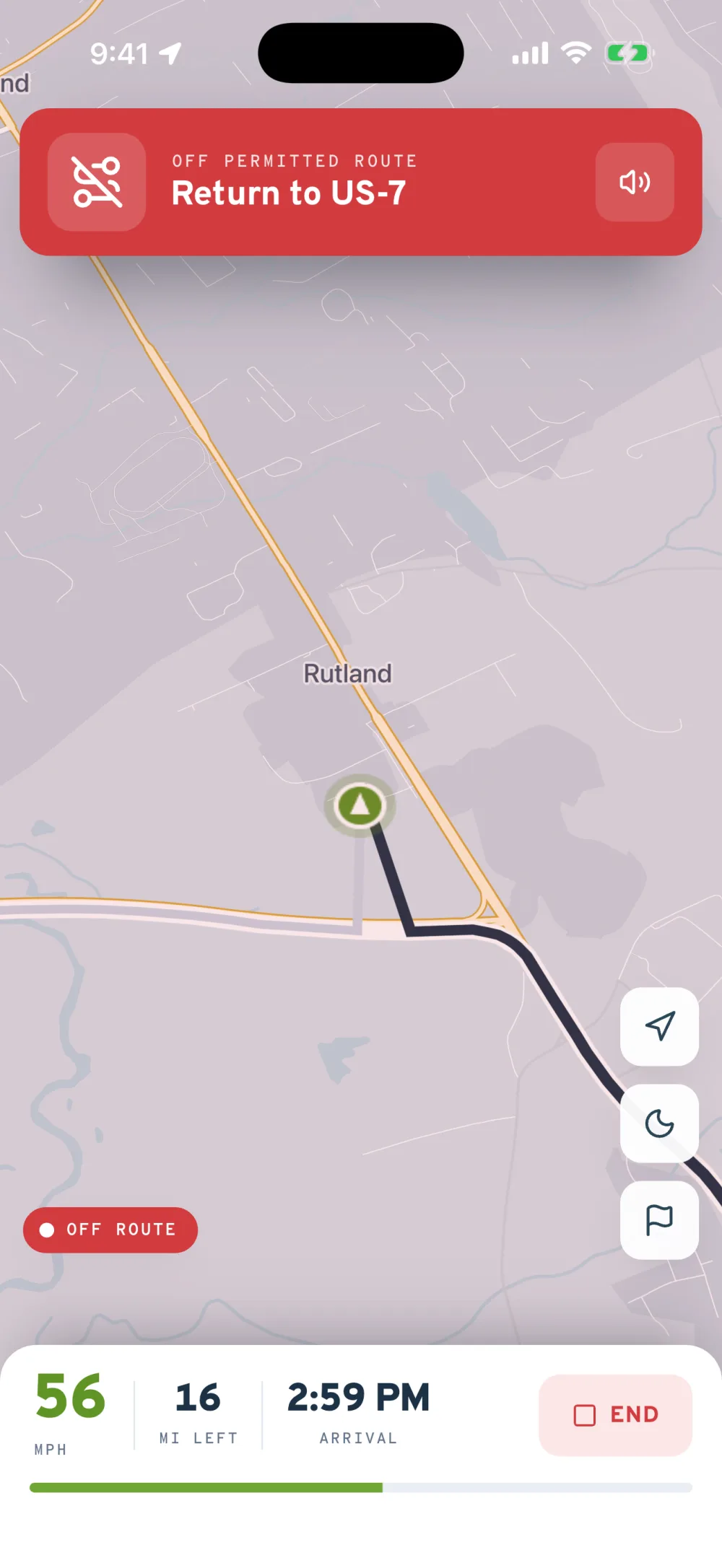
Off routeA red banner when you leave the route
41 states and 2 provinces covered on official route data.
A state or province counts as covered when live permits there have a route verified on an official source. Each one counts once, under the source most of its permits use. Look up your state before a move.
See every state and province-
State and province road data
29 states and 2 provinces
We build the route on the road data the state or province itself publishes, and match the roads and junctions your permit names on it.
-
State permit portal route
9 states
Some state permit portals publish a route line for each permit. We load that line and run the same checks on it. The app needs the portal link on your permit, or a permit number it can look up.
-
Permit system route data
3 states
Some states issue permits through a system that supplies its own route data. We check your route against that data. This data belongs to the permit system and is separate from the state's own road data.
Common questions.
What if a road on my permit is closed?
Call the permit office that issued the permit and follow any police officer directing traffic. Do not let a GPS invent a detour. Ask the office how to amend the permit if the route has to change.
Can I ever leave the permit route?
Only where a police officer directs you or your state's rules allow it. North Carolina, for example, allows up to one mile off a permitted interstate segment onto another state highway for access, if you cross no bridges and exceed no posted weight limits. Check your own permit and state rules.
What should I do after a wrong turn?
Get back to the permitted route by the safest legal way you can, and do not keep driving unlisted roads. If you cannot return without a long detour, call the permit office.
Do my escorts need the route too?
Yes. FHWA's pre-trip meeting guidance says every team member should know the route turn by turn, rear escort drivers included.
Keep reading
Scan your next permit and drive the route it approves.
Download Route Pilot Pro on iPhone or Android, scan the QR code on your permit and start the drive.