
Wide load permits, from the 102-inch line to the banner on your bumper.
A wide load is an oversize load that goes past the legal width. Width is the one size limit the federal government fixes on major highways, so the trigger is the same in most places. What changes from state to state is what your permit asks of you once you go past it.


Search for a wide load permit and you are looking for an oversize permit issued for width. “Wide load” is the everyday name for a load past the legal width, and many permit offices use “wide” as shorthand in their own rules. On the permit itself, width sits beside height and length as one of the dimensions the state approves.
When a load counts as wide
Federal law fixes width on the National Network, which covers the Interstate System plus other designated highways. Under 23 CFR 658.15(a), no state may set a width limit “of more or less than 102 inches” there, and Hawaii keeps 108 inches. Section 658.15(c) lets states grant special permits for vehicles wider than 102 inches. That special permit is your wide load permit.
States commonly use the same number off the network. North Carolina sets 102 inches on all roads in the state. Minnesota and Oklahoma both list 8 feet 6 inches as the point where you need a permit.
What counts in the measurement. Under 23 CFR 658.16 you measure from a point on one side to the same point on the other. Rear-view mirrors, turn signal lamps, handholds, splash and spray suppressant devices and load-induced tire bulge do not count, and neither do non-property-carrying devices that stick out no more than 3 inches on each side. The load always counts.
How width changes your permit
Once you go past the legal width, width drives many of the conditions on your permit.
Escorts. North Carolina’s Publication E-9 calls for a front escort for loads over 12 feet wide on two-lane highways, and three escorts for loads over 16 feet wide, one of them from the State Highway Patrol. Minnesota requires a certified rear escort on multi-lane divided roads when a load exceeds 15 feet wide, measured at the bottom. Pilot car rules change at each state line. See pilot car rules by state and how to check escort requirements.
Permit type. North Carolina’s annual permit caps general commodities at 12 feet wide, so a wider load needs a single-trip permit. At 17 feet wide or more, North Carolina treats the move as a superload with longer review.
Road restrictions. Oklahoma’s restriction list posts entries such as “10 WIDE RESTRICTION” and “NO WIDE LOAD RESTRICTION” on specific highway segments, which close those segments to loads past the posted width.
Banners. Pennsylvania requires yellow signs at least 7 feet wide by 18 inches high “containing only the words ‘OVERSIZE LOAD’” unless the permit says otherwise, so a WIDE LOAD banner does not meet the rule there on its own. North Carolina allows “Oversize Load” or “Wide Load” and requires banners front and rear on combinations permitted for more than 10 feet wide. On a multi-state move, OVERSIZE LOAD is the safer wording. The glossary entry on wide load vs oversize load has the details.
Wide load permits by state
Every state issues its own permit, so a wide load crossing three states needs three permits. The post on where to apply for an oversize permit lists the official office and online system for 14 states. Each state page shows the permit agency we hold on file and links the official permit information where we have it, for example Arizona, Illinois, New York and Washington. When you apply, give the overall width at the widest point of the load, including anything past the deck edge. The oversize load permit page walks through the rest of the application.
Driving a wide load on the permitted route
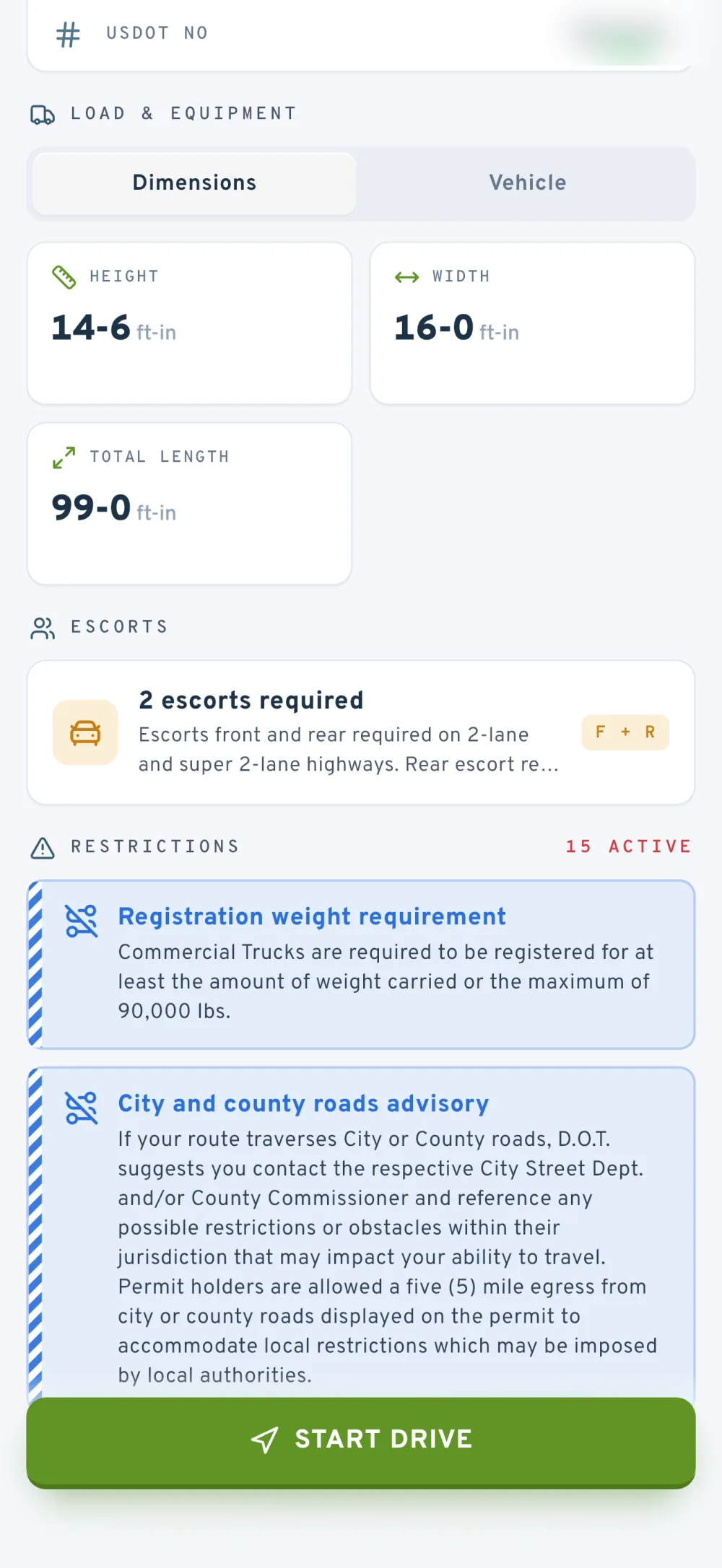
A wider load leaves less room for a wrong turn, and the state picked your roads with your width in mind. Route Pilot Pro reads your permit from its QR code or PDF and shows your load height, width and total length next to the escorts the permit requires. The restriction cards list the restrictions it read from the permit, such as lane and bridge rules, and the most serious one appears at the top of the screen when you start the drive. The app guides you along the permitted route by voice and warns you on screen and out loud if your position moves more than 250 meters, about 820 feet, from the route line. You still carry the paper permit, and the permit decides what is legal.
Sources
Checked 2026-11-05.
- 23 CFR Part 658 (sections 658.15, 658.16), eCFR: https://www.ecfr.gov/current/title-23/chapter-I/subchapter-G/part-658
- FHWA, Oversize/overweight permits, Federal requirements: https://ops.fhwa.dot.gov/freight/sw/permit_report/index.htm
- NCDOT, Oversize/Overweight Permit Handbook: https://connect.ncdot.gov/business/trucking/Documents/Oversize%20Overweight%20Permit%20Handbook.pdf
- NCDOT Publication E-9, Escort Vehicles: https://connect.ncdot.gov/business/trucking/Documents/Publication%20E-9.pdf
- NCDOT, Superload Publication SL-6: https://connect.ncdot.gov/business/trucking/Documents/Superload%20Publication%20(SL-6).pdf
- MnDOT, Determine if you need a permit: https://www.dot.state.mn.us/cvo/oversize/determine.html
- MnDOT, Escort requirements: https://www.dot.state.mn.us/cvo/oversize/escorts.html
- Oklahoma DOT, Size and Weight Permits: https://oklahoma.gov/odot/about-us/laws-and-rules/size-and-weight-permits.html
- ODOT, Restriction List: https://oklahoma.gov/content/dam/ok/en/odot/about-us/laws-rules/size-and-weight-permits/size-weight-restrictions/restriction-list.pdf
- 67 Pa. Code 179.10: https://www.pacodeandbulletin.gov/Display/pacode?file=/secure/pacode/data/067/chapter179/s179.10.html
Real screens from Route Pilot Pro.
-
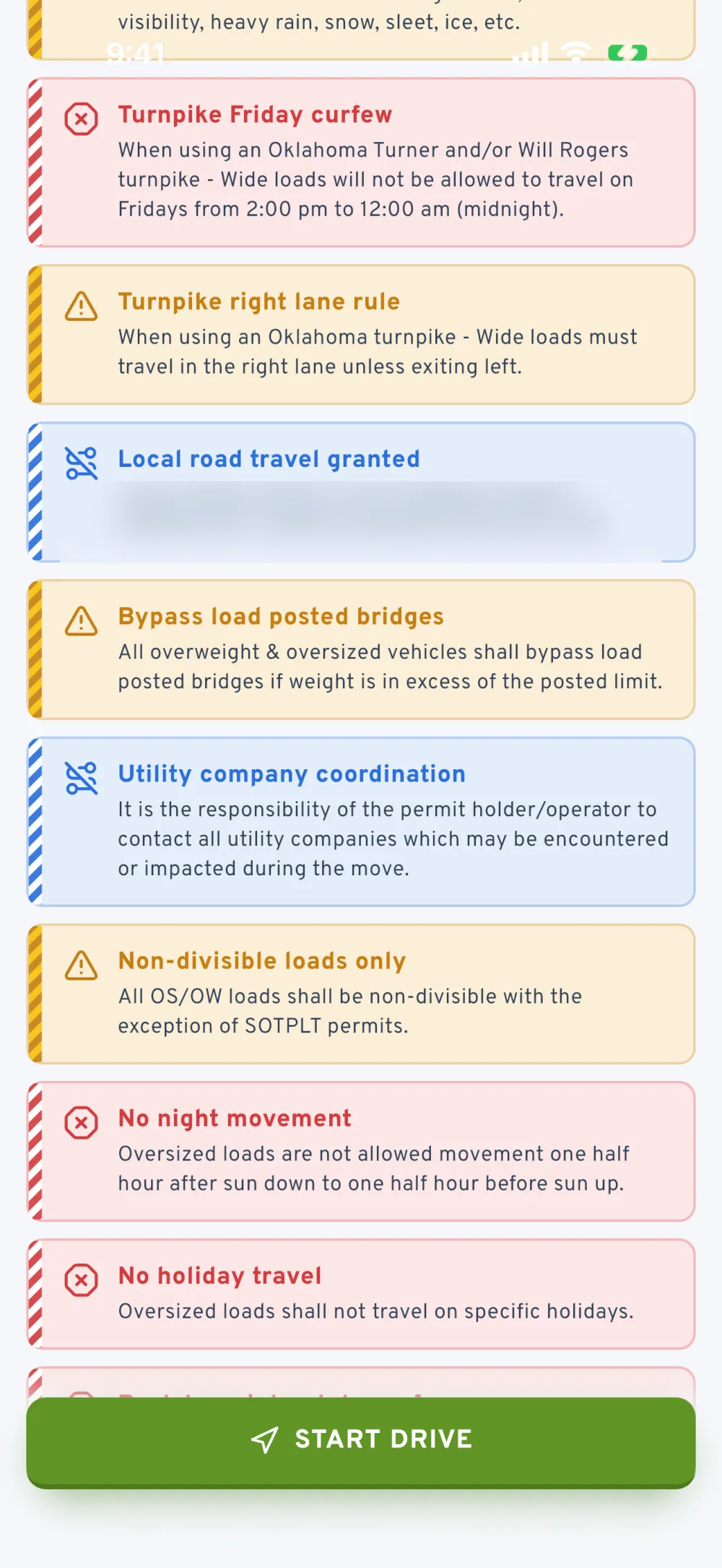
RestrictionsRestrictions listed from the permit
-
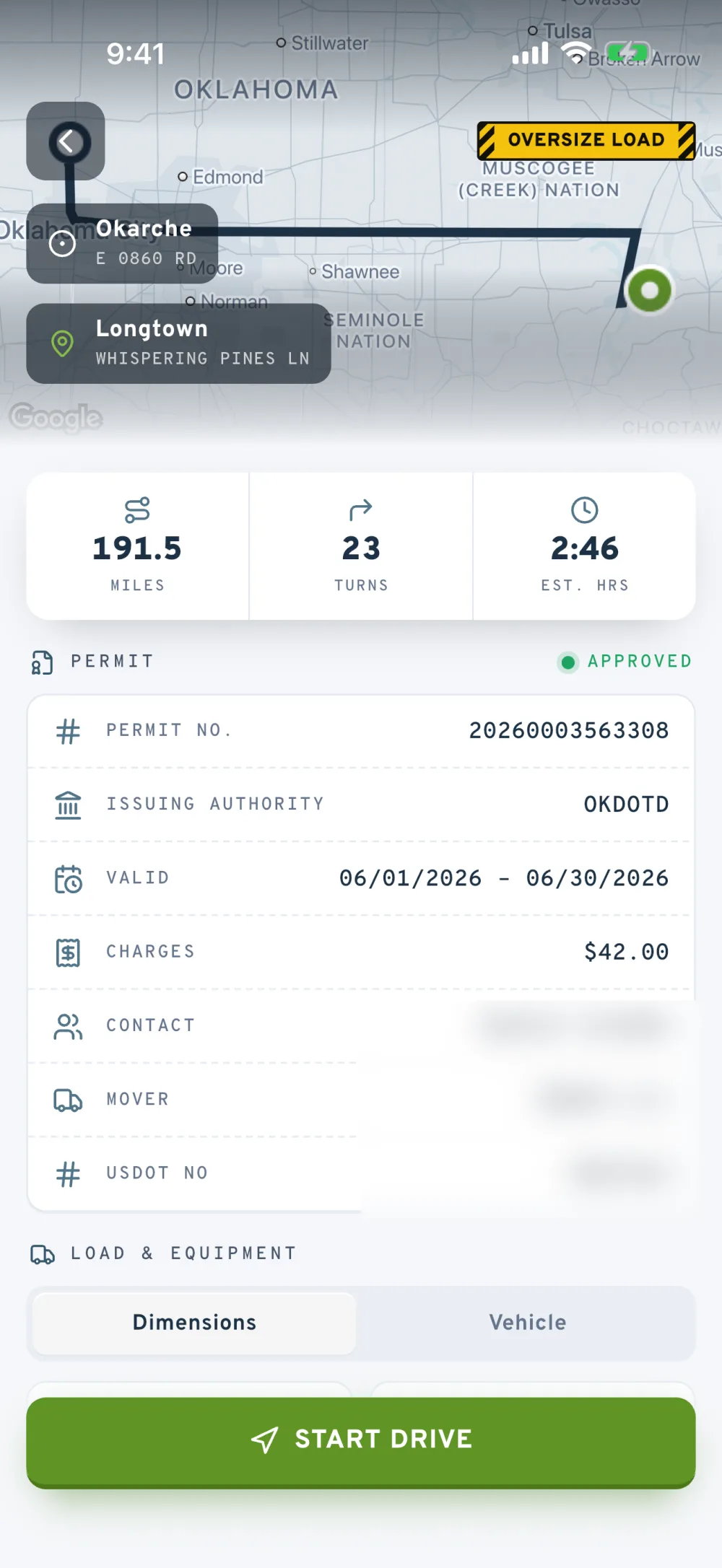
ReviewRoute review: 191.5 miles, 23 turns, 2:46 estimated hours
41 states and 2 provinces covered on official route data.
A state or province counts as covered when live permits there have a route verified on an official source. Each one counts once, under the source most of its permits use. Look up your state before a move.
See every state and province-
State and province road data
29 states and 2 provinces
We build the route on the road data the state or province itself publishes, and match the roads and junctions your permit names on it.
-
State permit portal route
9 states
Some state permit portals publish a route line for each permit. We load that line and run the same checks on it. The app needs the portal link on your permit, or a permit number it can look up.
-
Permit system route data
3 states
Some states issue permits through a system that supplies its own route data. We check your route against that data. This data belongs to the permit system and is separate from the state's own road data.
Common questions.
How wide can a load be without a wide load permit?
On the National Network, 102 inches, or 8 feet 6 inches. Hawaii keeps 108 inches. Mirrors, turn signals and a few other devices do not count, and the load itself always does.
Is a wide load permit different from an oversize permit?
States treat width as one dimension on an oversize permit. North Carolina, for example, lists overwidth, overheight and overlength under the same single-trip and annual permit types.
Should my banner say WIDE LOAD or OVERSIZE LOAD?
Check each state. Pennsylvania requires signs with only the words OVERSIZE LOAD unless the permit says otherwise. North Carolina accepts either legend. On a multi-state move, OVERSIZE LOAD is the safer wording.
How do I find wide load permit rules by state?
Start with the state's permit office. The post on where to apply lists 14 states, and each state page on this site links the official permit information where we hold it.
Keep reading
Scan your next permit and drive the route it approves.
Download Route Pilot Pro on iPhone or Android, scan the QR code on your permit and start the drive.